红楼梦
【品格道口 美食育爱】年味入粥香 欢乐意更浓——第十九周美食早知道_我的网站

一 |
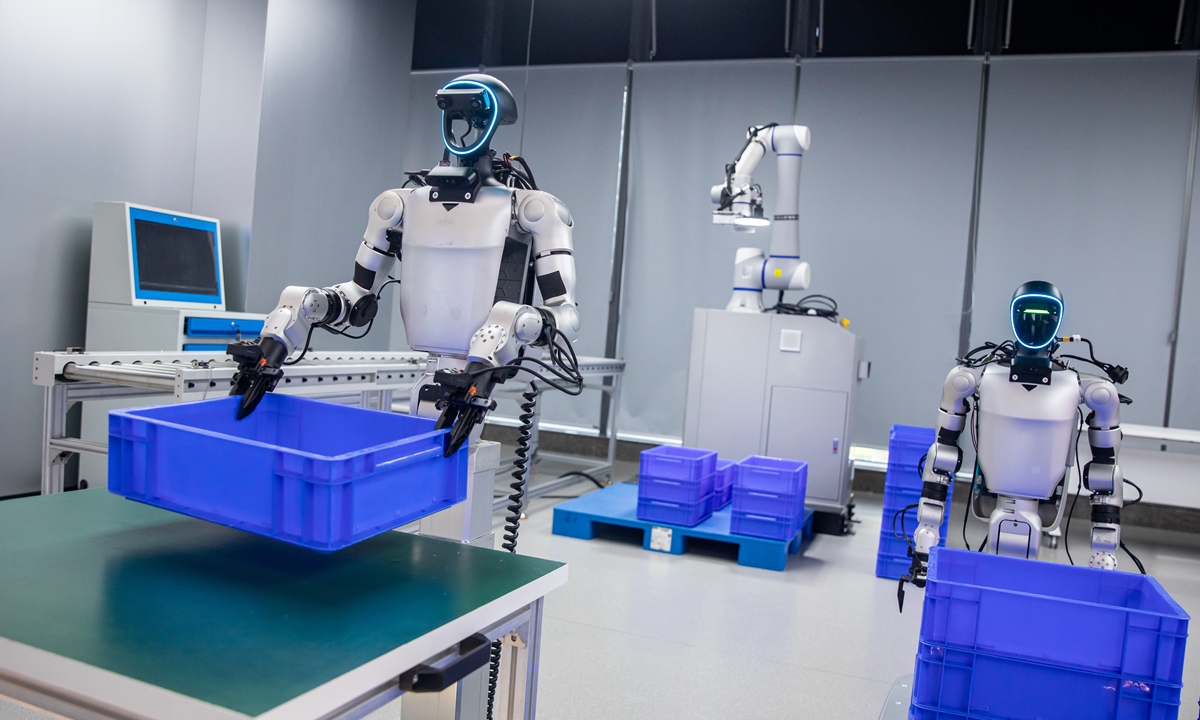
Robots conduct logistics and warehousing scenario training at an embodied intelligence exhibition center in Hangzhou, East China's Zhejiang Province, on June 11, 2026. Photo: VCG
Consumer-oriented embodied AI model developer Noin Intelligence announced a 500-million-yuan ($74.1 million) Angel++ funding round on Monday, the company said in a statement, marking another major capital inflow into embodied AI models as investors turn their attention toward the "brains" behind robots.
According to the statement, the company plans to channel the funding into developing more generalizable embodied AI models, advancing iterations of its GLOW generative model, and accelerating product validation and mass production.
Industry experts noted that a broader shift in the robotics race, with competition moving beyond hardware performance toward the development of core intelligence capabilities. While hardware forms the physical foundation of robots, embodied AI models determine their ability to perceive, learn, reason and adapt in real-world environments, making them a key factor in unlocking future opportunities.
The funding momentum extends beyond Noin Intelligence, with several other companies recently securing major financing rounds that are largely focused on advancing their AI models.
On August 3, Wuxi-based embodied intelligence company DISCOVER Robotics secured a $100 million Angel+ funding round, shortly after completing its initial angel financing of more than $100 million, according to Wuxi Fabu, the official WeChat account of the local government.
The company later introduced ORION, a hierarchical embodied intelligence foundation model, as well as LOOP, a virtual-real hybrid data closed-loop system, and DISCOVERSE, a high-fidelity simulator. The solutions are designed to tackle two major challenges facing the embodied intelligence — data scarcity and limited generalization — and accelerate the development of more capable AI systems, according to Wuxi Fabu.
In addition, according to industry media reports on August 3, Ant Lingbo, Ant Group's embodied intelligence subsidiary, has launched its first round of financing, seeking to raise 1.5 billion yuan.
The company aims to complete a second funding round by the end of this year. The company later confirmed to media that it was in discussions with investors, saying that as a core initiative of Ant Group's embodied intelligence strategy, it will continue to focus on developing general-purpose robotic brains, increase investment in embodied-native technology pathways, and accelerate industrial deployment.
The shift is also reflected in the fundraising priorities of publicly listed candidates.
Notably, Unitree Robotics, which has recently drawn widespread attention from the capital market, officially opened IPO subscriptions on Monday. According to its prospectus registration document disclosed by the Shanghai Stock Exchange on June 2, the company plans to raise 4.202 billion yuan through the IPO, with nearly half of the proceeds earmarked for its intelligent robot model R&D project.
Of the total proceeds, 2.02 billion yuan will be allocated to the intelligent robot model development project, significantly exceeding the 1.11 billion yuan planned for robot body R&D, highlighting the company's focus on developing the AI capabilities that power robots.
Wang Peng, an associate research fellow at the Beijing Academy of Social Sciences, said the latest financing trend shows that capital is reassessing where the core value of robotics lies. Investors are increasingly moving beyond robot hardware itself and treating embodied AI models and robotic "brains" as high-value assets, with capital flowing more toward software, algorithms and intelligence capabilities, he told the Global Times on Monday.
The valuation framework is also being reshaped, with investors paying greater attention to real-world deployment, customer adoption and repeat demand rather than hardware specifications or corporate narratives alone. Whether robots can operate reliably in real application scenarios has become a key benchmark for investment decisions, Wang said.
He added that increased investment in embodied AI models and generative world models could help address the structural gap between general-purpose AI models and physical-world interaction by expanding the supply of real-world interaction data. Capital is also increasingly favoring companies aligned with the country's long-term industrial priorities and emerging industry development plans, he said.
According to data from IT industry research platform ITjuzi.com, financing in China's embodied intelligence sector totaled 93.5 billion yuan in the first half of 2026, surpassing 90 billion yuan and marking a fivefold increase from the same period in 2025. The number of financing deals reached 322, up 137 percent year-on-year.
As China enters the first year of its 15th Five-Year Plan period (2026-30), policy priorities are placing greater emphasis on developing emerging industries, with the country accelerating AI development and promoting its integration with various sectors, Chinese experts noted. Meanwhile, as global AI development enters a new stage driven by broader applications and deeper industry integration, embodied intelligence is expected to unlock significant growth potential.
Driven by policy support and rapid industry evolution, the nation's upstream and downstream segments of the AI industry have gained momentum, achieving notable progress.
According to a Bloomberg's Monday report, China's humanoid robot makers commanded more than 97 percent of global shipments in the first half of 2026, according to new industry data affirming the country's early lead against US rivals in the burgeoning field.
Meanwhile, global humanoid robot shipments totaled roughly 19,100 units in the first half of 2026, more than triple the 5,100 units shipped in the same period last year, according to data from Smart Analytics Global. Data further noted the California-based research firm expects shipments to rise to around 60,000 units this year and reach half a million by 2030.
。 过了腊八就是年
一年一岁一团圆
年味入粥香 欢乐意更浓
— 中华传统节日 —
一年一岁一团圆,过了腊八就是年,
香香甜甜的腊八粥,幼儿园里的烟火气。
新年的仪式感,就从腊八节开启吧!
祝大朋友、小朋友万事“粥”全,平安喜乐!
上周美食回顾
星期一
星期二
星期四
星期五
下周美食预告
1月6 星期一
酥酥脆脆的香煎带鱼我最爱
开心元气早餐
大米糯蛋糕
极品蒸蛋羹
大枣银耳粥
幸福香果时光
烤梨
棒棒奶酪
四宝水果羹
百变魔法午餐
紫薯米饭
果仁菠菜
香煎带鱼
蜜汁肘子
豆腐鲜汤
甜心下午茶
蛋挞
鲜牛奶
1月7 星期二
鸡翅虾滑焖,QQ弹弹一口香
开心元气早餐
黄米糖包
香煮鸡蛋
糯香腊八粥
幸福香果时光
烤香蕉
暖蒸苹果
桔子蜂蜜姜茶
百变魔法午餐
奶香小馒头
脆炒西葫芦
彩椒土豆丝
鸡翅虾滑焖
西红柿蛋汤
甜心下午茶
鲜奶
烤红薯
菠萝酥
1月8 星期三
是红烧排骨的味道哦
开心元气早餐
三鲜小馄饨
五香鹌鹑蛋
幸福香果时光
棒棒奶酪
暖蒸苹果
蜂蜜金桔桂花羹
百变魔法午餐
黄金米饭
番茄炒蛋
什锦三丝
红烧排骨
羊肉滋补汤
甜心下午茶
鲜奶
贝贝南瓜
杏元饼干
1月9 星期四
来一笼热气腾腾酱肉香菇包
开心元气早餐
三鲜肉丝面
鲜蔬炒鸡蛋
幸福香果时光
烤香蕉
暖蒸橙子
百香果雪梨甜汤
百变魔法午餐
酱肉香菇包
粉丝小白菜
补气红豆粥
甜心下午茶
鲜奶
烤腰果
香蕉条
1月10 星期五
经典把子肉,满满的幸福感
开心元气早餐
营养鸡蛋堡
颗粒花生酱
奶香玉米糊
幸福香果时光
火龙果
砂糖桔
批把雪梨金桔汤
百变魔法午餐
芝麻香米饭
经典把子肉
青菜豆皮丝
三色小炒皇
火腿冬笋汤
甜心下午茶
鲜奶
牛舌酥
供稿|膳食团队
编辑|周忠仁
审核|宣传团队。
Current article:http://p402j.jiubengtaibingpengou.pics/list_x57jzt7/jp02zag.html
Published on:02:45:09